ICYMI in HousingWire | HUD Action Ensures FHA Loans are for Americans Only
Following HUD Action, Homeownership Loans for Illegals and Non-Residents Drop
October 9, 2026
WASHINGTON - New data reveals Federal Housing Administration (FHA) loans for non-permanent residents and illegals fell from 6% to nearly zero after the U.S. Department of Housing and Urban Development revoked their eligibility in May 2025.
“President Trump promised to put Americans first, and HUD delivered,” said Secretary Turner. “We are preventing illegals and non-residents from accessing taxpayer-backed programs at the expense of American homebuyers. Today, that share is zero. Make no mistake — exploit our citizens, and HUD will act.”
Watch Secretary Turner break down what this means for Americans:

Learn more from HousingWire:
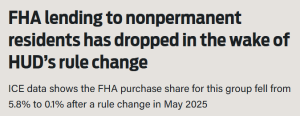
Changes to residency requirements for Federal Housing Administration (FHA) loans have sharply reduced the share of FHA purchase mortgages made to non-permanent residents, according to origination data from Intercontinental Exchange (ICE).
In March 2025, the Department of Housing and Urban Development (HUD) issued Mortgagee Letter 2025-09 and Title I Letter 490, removing the “non-permanent resident” category from FHA’s Single Family Title I and Title II programs, effective May 25, 2025.
Before the policy changes took effect, non-permanent residents accounted for about 5.8% of FHA purchase originations and 5.6% of purchase mortgages across the broader market, according to ICE data shared with HousingWire. After the changes, their share of FHA purchase loans fell to about 0.1%, while their share of purchase mortgages across all loan types declined by 2.2 percentage points to 3.4%, the data shows.
“President Trump promised to put Americans first, and HUD delivered,” Secretary Scott Turner said in a statement. “We are preventing illegals and non-residents from accessing taxpayer-backed programs at the expense of American homebuyers. Today, that share is zero. Make no mistake — exploit our citizens, and HUD will act.”
Market-specific impacts
The changes have had a larger impact in some markets where non-permanent residents had previously represented a relatively significant share of FHA purchase activity.
ICE evaluated markets with the highest non-permanent resident alien share of purchase originations prior to the FHA policy change (measured from second-quarter 2024 through first-quarter 2025) and filtered to the 100 largest U.S. markets and 33 markets along the U.S. borders with Mexico and Canada.
Utah markets recorded some of the largest declines. In Salt Lake City, non-permanent residents accounted for 26% of FHA purchase originations before the changes, compared with 0.15% afterward (Q4 2025 to the present). In Provo, the share fell from 20% to less than 0.5%.
Florida markets also saw declines. In Orlando, the pre-policy share went from 16.1% to a post-policy share of 0.2%. Lakeland went from 13.6% to 0.16%, and both Cape Coral and Miami went from 10% to less than 1%.
Other markets also recorded significant declines. Raleigh‘s share fell from 11.1% to 0.8%, while San Jose’s fell from about 10% to 0%.
The data suggests that conventional lending has not fully offset the decline in FHA lending to non-permanent residents. ICE data shows that non-permanent resident volume across conventional prime conforming loans remained relatively stable rather than increasing by a comparable amount.
“This new policy has definitely had an impact on families that would have qualified before May 2025,” said Michael Brown, a Tennessee-based home loan specialist at Churchill Mortgage. “Many of these borrowers are doing conventional loans now because Fannie Mae and Freddie Mac permit lawful non-permanent residents to obtain financing.”
Brown said that non-QM loans are another option for non-permanent residents, but that the new policy limits affordable financing options. “Some of these non-permanent residents will end up having to put more money down, work on improving their credit scores to qualify, or simply will need to wait until they obtain permanent-resident status,” he said.
Isaac Schultz, a Michigan-based home loan specialist at Churchill Mortgage, echoed that the only options for non-permanent residents are conventional financing or “some flavor of non-qualified mortgage financing.”
“I am currently working on a loan in one such scenario, and it does make it far more difficult for the borrower to qualify. For better or for worse, that was the main desired result of the policy change,” Schultz said.
Home price declines
It is unclear whether the declines have affected affordability, but most markets in the ICE dataset recorded lower prices after the policy changes took effect, according to HousingWire Data.
In Salt Lake City, the median list price for a single-family home ranged from $619,900 to $795,000 from Q2 2024 through Q1 2025. From Q4 2025 to the present, prices ranged from $620,000 to $742,450.
In Provo, the median list price ranged from $630,000 to $877,400 from Q2 2024 through Q1 2025, compared with $589,900 to $699,950 from Q4 2025 to the present.
Prices also shifted in Florida markets. In Orlando, the median list price ranged from $490,000 to $544,950 before the policy change, then dropped to a range of $489,000 to $525,000 afterward.
The change appeared to have no impact on prices in Lakeland, where they ranged from $350,000 to $374,999 before the change, and from $357,000 to $375,000 afterward. In Cape Coral, however, prices ranged from $475,000 to $510,000 before the policy changes, compared with $420,000 to $467,450 afterward.
In Raleigh, the median list price for a single-family home ranged from $579,900 to $699,000 before the change, but later dropped to $522,000 to $624,900.
San Jose, one of the nation’s most expensive markets, saw a smaller shift. The median list price for a single-family home there ranged from $1.56 million to $1.70 million from Q2 2024 through Q1 2025. From Q4 2025 to the present, prices ranged from $1.498 million to $1.70 million.
Follow @SecretaryTurner on X, FB, and Instagram.